
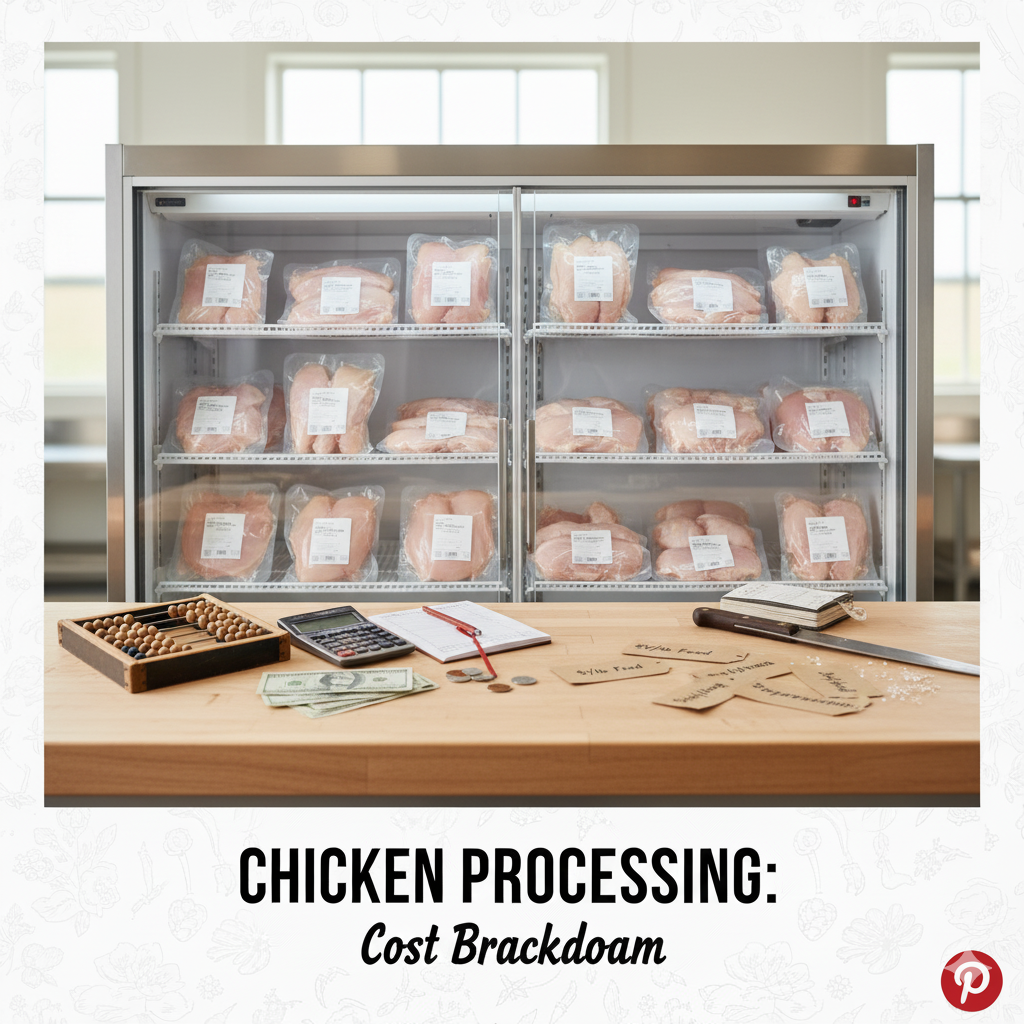
Raising your own meat chickens is rewarding, but processing comes with costs—whether you do it yourself at home or take birds to a commercial facility. Understanding the financial trade-offs helps you decide which route is best for your homestead. In this guide, we’ll break down the cost per bird, upfront equipment investment, and hidden expenses in both methods.
This post contains affiliate links which may allow for commissions at no extra cost to you.
Why Cost Matters in Processing
Processing is often the single biggest expense (after feed) in raising meat birds. For backyard chicken keepers, knowing your numbers ensures:
- You don’t overspend compared to store-bought chicken.
- You can price birds correctly if selling.
- You know when to scale up equipment or outsource.
Option 1: Processing at Home
Upfront Equipment Costs
Processing at home requires some one-time purchases:
- Kill cone – $20–$40 per cone (DIY options ~$10).
- Scalder – $200–$500 for propane/electric, or $50–$100 DIY turkey fryer setup.
- Plucker – $400–$1,200 for tub-style; $40–$80 for drill-powered.
- Knives + extras – $50–$100 for boning/fillet knives, lung remover, thermometer.
- Shrink bags & labels – $0.50–$1.00 per bird.
👉 Startup total: $700–$1,800 depending on gear.
Ongoing Per-Bird Costs
- Shrink bags: $0.50–$1.00
- Ice & propane: $0.50–$1.50
- Disposal (compost/gut pit): negligible if on-farm
👉 DIY processing cost per bird: ~$1–$2.50 (not including labor).
Labor Factor
A beginner may take 20–30 minutes per bird. With equipment + practice, you can process in 5–7 minutes each. If you value your time at $20/hour, that’s an extra ~$2–$3 labor cost per chicken.
Option 2: Commercial Processing
Standard Costs
Most USDA/state facilities charge by the bird:
- Basic processing: $4–$6 per chicken.
- Vacuum-sealing or cut-up: +$1–$2 per bird.
- Custom packaging/labeling: additional.
👉 For 50 birds: expect $250–$400.
Travel Costs
- Fuel to/from processor (often 1–2 hours away).
- Time spent dropping off + picking up.
Benefits of Commercial Processing
- USDA/State inspection allows legal resale beyond 1,000 bird exemption.
- Saves your time + mess.
- Professional packaging and labeling.
Cost Comparison: Home vs. Commercial
| Method | Upfront Costs | Per-Bird Costs | 50 Bird Batch | Notes |
|---|---|---|---|---|
| Home Processing | $700–$1,800 | $1–$2.50 | ~$75–$125 | Lower ongoing cost, higher labor |
| Commercial | $0 | $5–$7 | ~$250–$400 | Higher cost, but resale-ready |
Which Is Right for You?
- Small Flocks (10–25 birds): Cheaper to process at home, even with simple DIY tools.
- Medium Flocks (50–150 birds): Home processing pays off quickly if you plan multiple batches.
- Large Flocks (200+ birds/year): Commercial processing may be worth it for inspection + time savings.
Tips to Reduce Costs
- Split equipment costs with a neighbor or farm co-op.
- Build your own scalder (turkey fryer + thermometer).
- Use a drill-powered plucker for small batches.
- Process in bulk to maximize ice/propane use.
- Sell offal (livers, hearts, gizzards) if allowed—offsets cost.
Final Thoughts
The decision comes down to your goals:
- If you’re raising birds just for family, DIY processing gives you maximum savings.
- If you want to sell widely or scale production, commercial processing ensures compliance and frees up your time.
- Refer to The ultimate guide to processing meat birds for more information.
By knowing the real cost breakdown, you can make the right choice for your homestead and budget.